7 Things Pavlov’s Dogs Taught Us About the Gut–Brain Connection — And Why It Matters for Dogs Who Can’t Switch Off


1. Everyone Remembers Pavlov’s Bell — But Almost Nobody Remembers What His Dogs Actually Revealed
Most people remember Ivan Pavlov for one thing: a bell that made dogs drool.
But that isn’t what earned him the Nobel Prize.
Pavlov’s groundbreaking work was actually centered on digestion — including how signals from the nervous system could influence what was happening inside a dog’s digestive system before food had even reached the stomach.
It was an early clue that the nervous system and digestive system weren’t operating as two completely separate worlds.
Today, we understand this broader two-way communication as part of the gut–brain axis.
And more than 120 years later, it raises an important question for owners of reactive dogs:
What if we’ve been focusing so much on the behavior that we’ve overlooked another system involved in the response?
A dog appears across the street.
A bicycle passes.
Someone knocks at the door.
The trigger may last only seconds — yet the barking, lunging, pacing, scanning, or inability to settle can continue much longer.
Training can still matter.
But the gut–brain connection suggests there may be more happening beneath the behavior than what we can see from the outside.
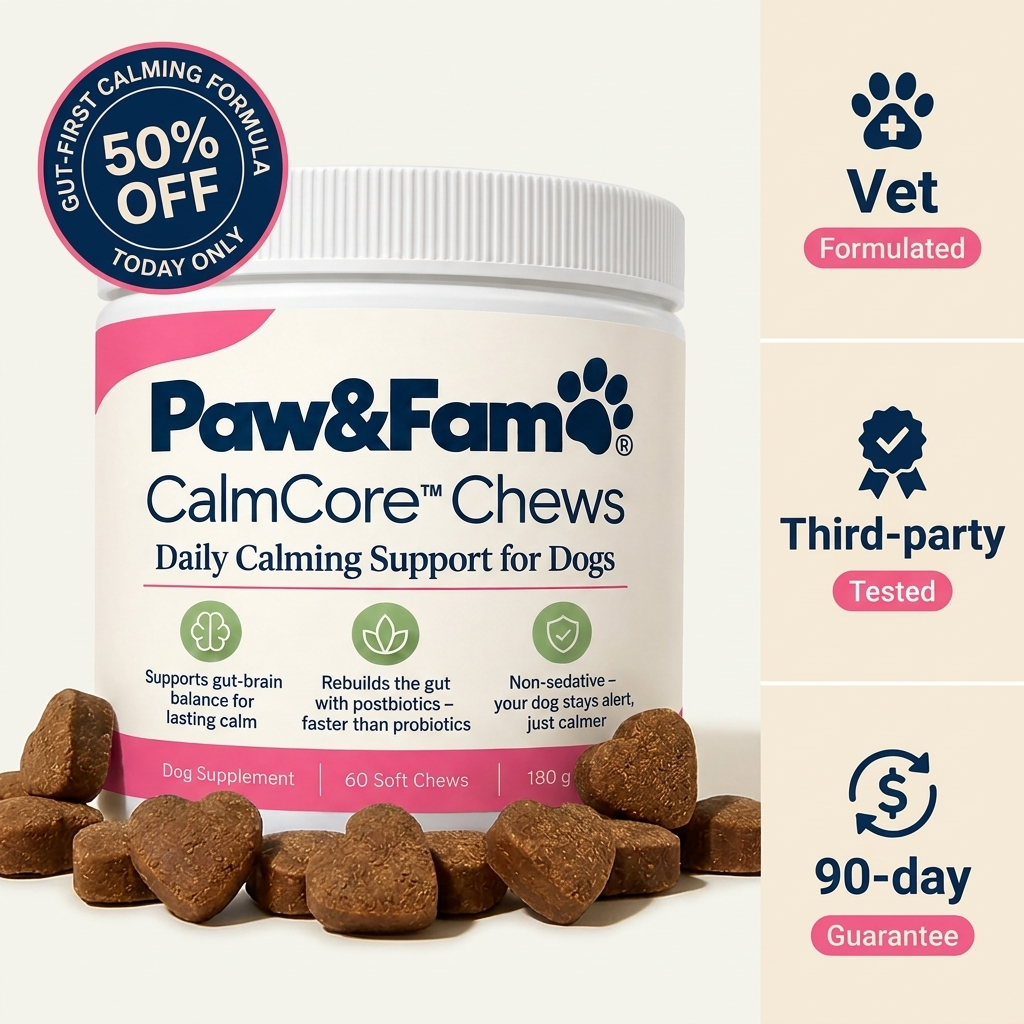
That’s why Paw&Fam CalmCore™ Chews were built around daily postbiotic gut–brain support.
Not to knock your dog out.
Not to replace training.
And not to turn them into a different dog.
The goal is much simpler:
Support another system involved in how your dog responds to everyday stress and comes back down afterward.
Because sometimes the missing piece isn’t another way to control the reaction.
It’s realizing there may be another system worth supporting.
“Before CalmCore, every walk felt like I was planning an escape route. I was constantly scanning for dogs, bikes, anything that might set him off. After using it consistently, I started noticing that he recovered faster and could settle again instead of staying worked up. He’s still my same goofy dog — just easier to help back to calm.”

2. The Signal Doesn’t Only Travel From The Brain To The Gut — It Goes Both Ways
Pavlov’s work showed something important:
The nervous system could influence digestion before food had even reached the stomach.
But modern research has taken that idea much further.
We now know the communication doesn’t run in just one direction.
The gut sends signals back to the nervous system too.
That means stress can affect what happens inside the gut — while signals coming from the gut can also interact with systems involved in stress, arousal, and behavior.
And suddenly, reactive dogs start to look a little different.
Your dog sees another dog.
Their body goes on alert.
The other dog disappears.
But yours is still staring down the street.
Still pulling.
Still pacing when you get home.
Still reacting to the next little sound.
The visible behavior may be happening on the outside — but that doesn’t mean the whole story starts and ends there.
That was the realization behind the veterinary investigation in the Max story:
What if we’ve been focusing on the reaction... while overlooking another system involved in the response?
Training can still help teach your dog what to do around a trigger.
But the gut–brain connection suggests there may also be value in supporting what’s happening beneath the behavior.
And that’s where the story starts getting really interesting.
“I’d tried calming chews before and either noticed nothing or my dog just seemed sleepy. With CalmCore™, the first thing I noticed was that he could actually come back down after something set him off. He still notices other dogs and loud noises — he just doesn’t stay wound up for as long. And he still acts completely like himself. The best part? He thinks the chew is a treat.”

3. The Real Problem May Not Be The Trigger — It’s How Long Your Dog Stays “On” After It
A dog appears across the street.
Your dog lunges.
The other dog keeps walking.
And technically, the moment is over.
But for your dog?
It may be far from over.
They’re still scanning the street.
Still pulling.
Still panting.
Still reacting to sounds that normally wouldn’t matter.
And when you finally get home, they may pace around instead of simply lying down.
That’s the pattern so many reactive-dog owners recognize:
The trigger lasts seconds. The recovery can take much longer.
And that matters because the gut–brain connection isn’t just involved in what happens during a stressful moment.
Stress and the digestive system can influence one another in both directions.
So the more we looked at dogs like Max, the more important a different question became:
Why are some dogs able to come back down after a trigger… while others seem to stay stuck “on”?
Most approaches naturally focus on the reaction:
Stop the lunging.
Stop the barking.
Create more distance.
Redirect their attention.
Those things can absolutely matter.
But what if we’ve been paying so much attention to what sets the dog off that we’ve overlooked what helps them recover afterward?
That’s the shift behind the CalmCore™ approach.
Not trying to create a dog who never notices another dog, bicycle, stranger, or sound.
Supporting the gut–brain system involved in helping them return to a calmer baseline once the moment has passed.
Because sometimes the biggest improvement isn’t:
“My dog never reacts anymore.”
It’s:
“My dog can finally come back down.”
“I never thought my dog’s gut had anything to do with how hard it was for him to settle. I’d already tried training and several calming products. What surprised me with CalmCore™ wasn’t that he became sleepy — he didn’t. He just started coming back down more easily after things that used to keep him on edge for ages.”

4. Training Can Change The Behavior — But It May Not Be The Whole Picture
For years, reactive-dog advice has focused on what we can see:
The barking.
The lunging.
The staring.
The pulling.
The snapping.
So naturally, the solution has been to work on the behavior.
Create distance.
Redirect attention.
Use counter-conditioning.
Practice calmer responses around triggers.
And those things can absolutely matter.
But the veterinary investigation behind Max’s story raised a different question:
What if behavior is only one part of the system we should be supporting?
After Max’s case, the team began looking more closely at reactive dogs who had already been through training, behavior programs, calming supplements, and carefully managed routines — yet were still struggling.
That’s what made the gut–brain connection so interesting.
Because if the gut and nervous system are constantly communicating, then supporting calm may involve more than teaching a dog how to respond when another dog appears.
It may also mean supporting the internal systems involved in stress and recovery.
That doesn’t make training pointless.
It means training may not have to carry the entire burden by itself.
And that’s the idea behind CalmCore™:
daily postbiotic gut–brain support designed to sit alongside the work you’re already doing.
Because sometimes the breakthrough isn’t finding a better training technique.
It’s realizing there may be another system worth supporting too.

5. The Best Time To Support Calm May Be Before The Next Trigger Happens
Most calming products enter the picture after your dog is already worked up.
After the barking starts.
After the leash goes tight.
After they’re pacing around the house.
After you’re already trying to get them back under control.
But the Max investigation pushed the team toward a different way of thinking.
If the gut and nervous system are communicating every day, then supporting that system shouldn’t only happen after something goes wrong.
It should become part of the dog’s normal routine.
That’s what made postbiotic gut–brain support so interesting.
Instead of waiting for the next difficult walk or unexpected trigger, the goal is to provide consistent daily support for the system involved in stress and recovery.
Because you can’t always predict when:
A dog will appear around the corner.
A bicycle will pass too close.
Someone will knock at the door.
Or a stranger will suddenly approach.
But you can support your dog before any of those moments happen.
That’s why CalmCore™ isn’t positioned as something you only reach for during a bad day.
It’s designed as a daily postbiotic routine built around the gut–brain connection the veterinary team had begun focusing on. The advertorial similarly presents postbiotics as the different system they turned toward after examining reactive dogs who had already been through training and other approaches.
One simple routine.
Every day.
Support the baseline before the next trigger ever appears.
“I used to avoid walking after 7 AM because there were too many dogs out. I’m still careful, but I don’t feel like every walk has to be an escape plan anymore. He settles much faster when something does set him off.”

6. Not All Gut Support Works The Same Way
Once the veterinary team started looking at the gut–brain connection, another question came up:
If gut health matters, why not just give a probiotic?
That’s what most dog owners would naturally think.
But probiotics and postbiotics work differently.
Traditional probiotics rely on live bacteria.
Postbiotics take a different approach — they provide non-living microbial components and compounds associated with beneficial microbial activity, without depending on live bacteria remaining alive.
And that distinction became important in the Max investigation.
The advertorial describes the team moving beyond standard probiotics and focusing instead on postbiotic metabolites and gut–brain support as the overlooked piece.
That’s why CalmCore™ wasn’t designed as just another generic probiotic chew.
It was built around a daily postbiotic approach.
No waiting for live bacteria to “take hold.”
No complicated protocol.
Just consistent daily support designed around the gut–brain system we’d been overlooking.
Because once you start asking:
“What system are we actually trying to support?”
The type of gut support you choose starts to matter too.
And that leads to the final piece.
“I wasn’t looking for a dog that never reacted to anything. I just wanted him to recover. That’s what I started noticing with CalmCore™ — he’d have a moment, then actually come back down instead of staying wound up.”

7. The Goal Isn’t A Different Dog — It’s A Dog Better Able To Regulate
After everything Max’s story revealed, one thing became clear:
The goal was never to shut reactive dogs down.
It wasn’t to make them sleepy.
It wasn’t to erase their personality.
And it wasn’t to create a dog who never notices another dog, person, bicycle, or unfamiliar sound.
The real goal is much more practical:
Help support the system involved in how your dog responds to stress — so they’re better equipped to come back down afterward.
That’s what makes the gut–brain approach different.
Training can help shape what your dog does around a trigger.
Management can create distance and prevent difficult situations.
But daily gut–brain support gives you another layer to work with — before, during, and after those moments.
And that’s ultimately why the veterinary team turned to postbiotics after investigating reactive dogs who were already using trainers, premium diets, CBD, and calming supplements.
That thinking became the foundation behind Paw&Fam CalmCore™ Chews.
A simple daily postbiotic routine built around the system most dog owners rarely think about when they see barking, lunging, staring, or pulling.
Because the outcome you really want probably isn’t:
“My dog became a completely different dog.”
It’s:
“That’s still my dog — they’re just better able to handle the world around them.”
Same dog. Better supported from the inside out.
“The biggest difference for me is that he doesn’t stay ‘on’ for the rest of the day anymore. He’ll still bark if something catches him off guard, but now he can actually lie back down instead of pacing around for an hour.”
100% Risk Free — 90-Day Guarantee
Pavlov’s breakthroughs came from observing the same systems over time.
CalmCore™ is built on that same idea: daily gut–brain support, not a one-off fix.
One chew. Every day.
Then watch the small things:
Does your dog come back down sooner?
Do evenings feel less “on”?
Does settling get a little easier?